
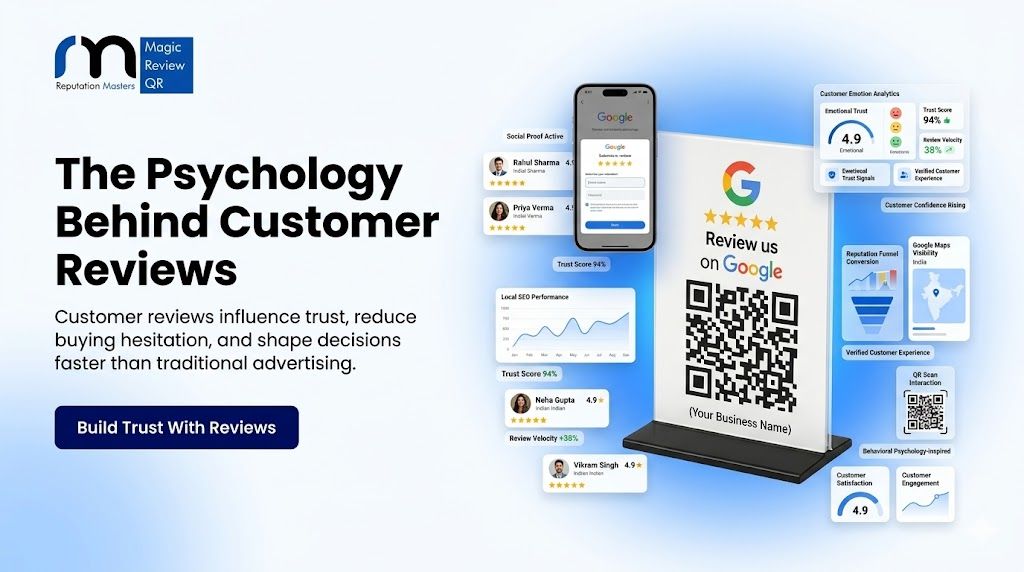
Customer reviews are not just feedback — they are a decision-making shortcut in the buyer’s mind. Most people don’t carefully evaluate every option; they rely on psychological signals like trust, social proof, and emotional validation.
That is why reviews influence buying behavior far more than advertising or branding alone.
1. Social Proof: “If others trust it, I can too”
The strongest psychological driver behind reviews is social proof.
When customers see others having a positive experience, their brain reduces uncertainty.
People think:
-
“Many others used this, so it must be safe”
-
“If they are happy, I will probably be fine too”
This removes fear of making a wrong decision.
2. Risk Reduction: Reviews Reduce Fear of Loss
Every purchase has perceived risk:
-
Will this service be good?
-
Will I waste my money?
-
Will I regret it?
Reviews reduce this mental risk.
A business with strong reviews feels:
-
safer
-
more reliable
-
less risky
So customers choose it even if it is slightly more expensive.
3. Trust Transfer: From Business to People
Customers don’t fully trust businesses — they trust other customers.
This is called trust transfer.
Instead of believing:
-
“This salon is good”
They believe:
-
“Other people like me had a good experience here”
This shift from brand trust to peer trust is why reviews are so powerful.
4. Emotional Decision Making (Not Logical)
Most buying decisions are emotional first and logical later.
Reviews trigger emotions like:
-
relief (“this place is safe”)
-
confidence (“others are satisfied”)
-
reassurance (“I am making the right choice”)
Even negative reviews influence decisions emotionally by creating doubt or hesitation.
5. The “Heuristic Shortcut” Effect magic review QR
The brain prefers shortcuts to save effort.
Instead of analyzing:
-
pricing
-
quality
-
branding
-
offers
Customers simply check:
-
rating
-
number of reviews
-
recent feedback
This is called a heuristic decision shortcut.
Stars and reviews replace deep thinking.
6. Recency Bias: Fresh Reviews Matter More
Customers trust recent reviews more than old ones.
Why:
-
Old reviews feel outdated
-
Recent reviews reflect current service quality
-
Fresh feedback feels more relevant
This is why consistent review flow is more powerful than one-time bulk reviews.
7. Quantity vs Quality Psychology
Both matter, but they influence differently:
-
Quantity builds credibility (“many people trust this”)
-
Quality builds confidence (“this is genuinely good”)
A business with:
-
100+ reviews feels established
-
4.5+ rating feels reliable
Together, they create maximum trust.
8. Negative Review Impact Bias
Interestingly, customers don’t expect perfection.
A few negative reviews can actually:
-
make the business look more real
-
increase trust in positive reviews
-
reduce suspicion of fake ratings
But too many negative reviews create immediate rejection.
9. The “First Impression Rule”
The first 3–5 reviews a customer reads often decide their final choice.
People rarely read all reviews.
They quickly scan:
-
latest reviews
-
top-rated experiences
-
worst complaints
Then they form an instant judgment.
10. Why Businesses Fail to Use This Psychology
Most businesses collect reviews but fail to use them strategically.
Common mistakes:
-
No system to collect consistent reviews
-
No focus on timing (asking too late)
-
No visibility strategy (reviews not showcased)
-
No funnel to convert satisfaction into public proof
So psychological opportunity is lost.
Final Summary
Customer reviews influence behavior because they:
-
Reduce perceived risk
-
Provide social proof
-
Transfer trust from people to businesses
-
Trigger emotional decision-making
-
Act as mental shortcuts in buying decisions
-
Create credibility through both quality and quantity
magic review qr