
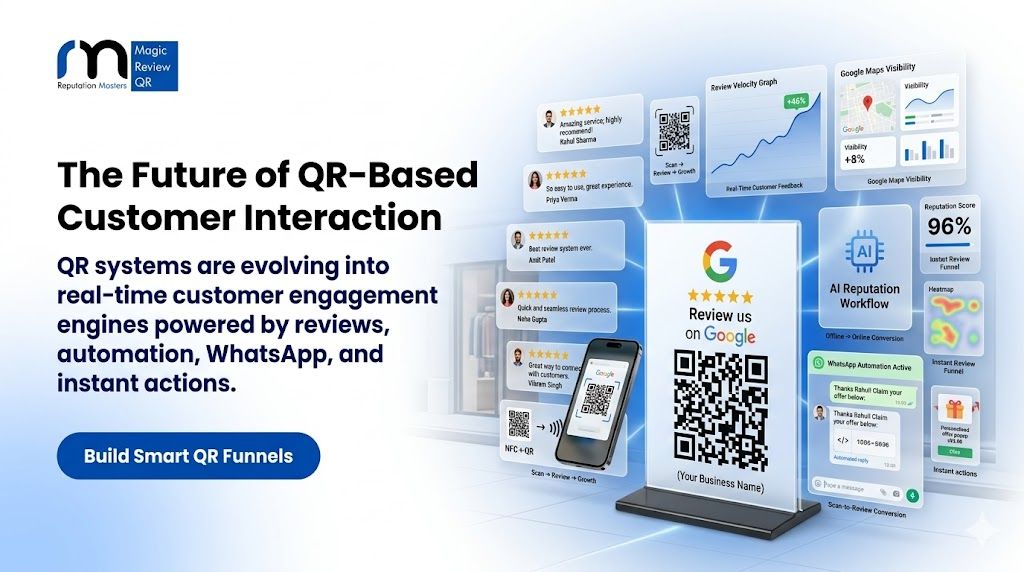
QR codes started as a simple convenience tool. Today, they are evolving into a full customer interaction layer between offline experiences and digital actions.
In the near future, QR-based systems will not just share information — they will trigger actions, automate marketing, and capture real-time customer intent.
1. From Static Links to Action Triggers
Earlier QR codes were used for:
-
menus
-
website links
-
payment pages
Future QR systems will become action triggers, such as:
-
leaving a Google review instantly
-
booking appointments
-
joining WhatsApp support
-
receiving personalized offers
-
submitting feedback in real time
Instead of “opening information,” QR codes will increasingly start workflows.
2. Offline-to-Online Conversion Engine
QR codes are becoming the most important bridge between physical and digital business.
Every offline moment can now become a digital action:
-
Customer exits a salon → leaves review
-
Customer finishes meal → scans to rate experience
-
Patient leaves clinic → submits feedback instantly
This converts real-world satisfaction into measurable online signals.
3. Real-Time Customer Intent Capture
One of the biggest future shifts is timing.
QR systems allow businesses to capture:
-
customer satisfaction at peak emotion
-
immediate feedback after service
-
buying intent in real time
This is powerful because:
Customer emotion drops quickly after the experience ends.
QR interaction ensures businesses capture that emotion instantly.
4. Rise of Smart QR Funnels
QR codes are evolving into structured funnels:
Step 1: Scan QR
Step 2: Choose action (review, feedback, referral, booking)
Step 3: Automated redirect or workflow
Step 4: Data captured for marketing
This turns QR codes into mini marketing systems, not just links.
5. Integration with WhatsApp and Automation Tools
In India especially, QR systems will increasingly connect to:
-
WhatsApp automation
-
CRM tools
-
review management systems
-
AI-driven responses
Example flow:
Scan QR → WhatsApp opens → automated message → review request → follow-up reminder
This makes QR codes part of a complete communication ecosystem.
6. Personalization Through QR Data
Future QR systems will not be generic.
They will adapt based on:
-
location
-
customer history
-
time of interaction
-
service type
This means:
-
different QR responses for different customers
-
personalized feedback or review links
-
targeted offers based on behavior
7. Magic Review QR Codes as Reputation Builders
One of the biggest shifts is that QR codes are becoming a reputation infrastructure tool.
They help businesses:
-
collect more Google reviews
-
maintain review consistency
-
improve local SEO visibility
-
build stronger trust signals online
In local markets, this directly affects ranking and revenue.
8. Replacement of Manual Feedback Systems
Traditional methods like:
-
paper feedback forms
-
manual review requests
-
delayed SMS follow-ups
are becoming outdated.
QR-based interaction is:
-
faster
-
automated
-
trackable
-
more scalable
Businesses are shifting toward instant feedback ecosystems.
9. Growth of NFC + QR Hybrid Systems
QR codes are now merging with NFC (tap technology).
This creates:
-
scan or tap options
-
faster interaction than typing or searching
-
more seamless offline experience
This hybrid model is becoming the new standard for customer engagement at physical locations.
10. The Future Vision: Invisible Marketing Systems
The long-term evolution of QR interaction is:
Customers will not feel marketing — they will just interact naturally.
Businesses will build systems where:
-
every visit generates data
-
every happy moment creates a review
-
every interaction feeds growth automatically
QR codes will quietly power this entire ecosystem.
Final Summary
The future of QR-based customer interaction is defined by:
-
Instant action-based workflows
-
Offline-to-online conversion
-
Real-time feedback capture
-
Integration with WhatsApp and automation tools
-
Smart, personalized QR experiences
-
Strong impact on reputation and local SEO